

People have probably told you there is nothing more anyone can do. The ENT ran tests and said your hearing is fine. The audiologist suggested a sound machine. Your doctor may have mentioned that you will eventually get used to it. But you have not gotten used to it. The ringing, the buzzing, the hissing, whatever shape your tinnitus takes, it is there when you wake up, it is there when you try to work, and it is there when you lie down at night, hoping for a quiet that never comes.
If this is your experience, we want you to know two things. First, what you are going through is real and it is exhausting, and you are not being dramatic about how much it affects your life. Second, tinnitus is not actually an ear problem. It is a brain problem. And that is why neurofeedback for tinnitus can help in ways that ear-level treatments cannot.
Why Tinnitus Lives in the Brain, Not the Ears
Most people assume that damage to the ear causes tinnitus, and in many cases that is where it starts. Noise exposure, age-related hearing changes, or an injury can trigger the initial signal. But the reason the sound persists long after the trigger is gone has to do with what happens in the brain afterward.
When auditory input is reduced or altered, the brain compensates by turning up its internal volume. Neural circuits in the auditory cortex become overactive, generating a signal where there is no external sound. Over time, other brain regions get involved. The limbic system, which governs emotion, starts attaching distress to the signal. Attention networks lock onto it. What began as a minor auditory event becomes a self-reinforcing loop: the brain generates the sound, the emotional system reacts to it, the attention system focuses on it, and the whole cycle deepens.
Research published through the National Institutes of Health has confirmed this model. Specific patterns of brain activity maintain tinnitus, not by ongoing damage to the ear. A 2021 review in Frontiers in Neuroscience further documented how aberrant neural synchrony in the auditory cortex sustains the tinnitus signal centrally. This is why hearing aids and sound masking help some people but fail to address the underlying problem for many others. The brain generates the signal, and that is where treatment needs to focus.
How Neurofeedback Targets the Tinnitus Pattern
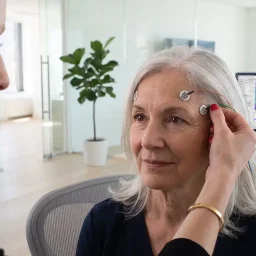
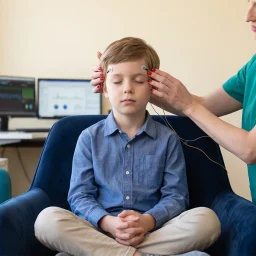
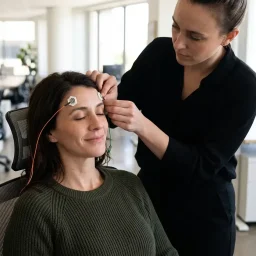
At Los Angeles Neurofeedback Center, we work by reading your brain’s own electrical activity in real time. In tinnitus cases, this typically reveals a recognizable pattern: overactivity in the auditory processing areas, heightened arousal in the limbic regions, and often disrupted activity in the areas responsible for attention and filtering.
Clarity Direct Neurofeedback delivers a micro-current signal so small that you cannot feel it. There is no buzzing, no tingling, no stimulation. The signal gently disrupts the stuck electrical patterns that are maintaining the tinnitus loop, giving the brain an opportunity to reset. It does not force the brain into a new state. It creates an opening for the brain to find its way out of the pattern trapping it.
Published research on neurofeedback for chronic tinnitus has shown that targeting the relevant brain regions can reduce tinnitus severity. A peer-reviewed study in Applied Psychophysiology and Biofeedback found that neurofeedback training aimed at the auditory cortex produced significant reductions in tinnitus loudness and distress. In many cases it also reduces the emotional distress that accompanies it, which matters because for most people, it is the combination of the sound and the reaction to the sound that makes tinnitus so debilitating. When the brain’s emotional and attentional response to the signal calms down, the experience changes even before the sound itself fully resolves.
What Relief Actually Looks Like
We want to be honest about what neurofeedback can and cannot do for tinnitus. Some people notice a significant decrease in the perceived volume. For others, the sound remains but the brain stops fixating on it, which means it fades into the background the way it does for the roughly 80 percent of tinnitus sufferers who habituate naturally. For nearly everyone, the anxiety, sleep disruption, and difficulty concentrating that accompany tinnitus improve, often substantially.
The changes tend to be gradual. After the first few sessions, many clients report that the tinnitus is less intrusive, not necessarily quieter, but less consuming. Sleep often improves early in the process, which makes sense because the same overactive brain patterns that maintain tinnitus also interfere with the brain’s ability to wind down at night. As treatment progresses, the periods of relief get longer and the intensity of the tinnitus on bad days becomes less severe.
A typical course of treatment is 15 to 25 sessions, though some tinnitus cases benefit from additional sessions depending on how long the condition has been present and how many brain systems are involved. We track progress throughout and adjust the approach based on what your brain’s activity and your lived experience are telling us.
The Connection Between Tinnitus, Anxiety, and Sleep
Tinnitus rarely travels alone. The constant sound creates a state of low-level stress that the nervous system treats as a persistent threat. This often leads to heightened anxiety, which makes the tinnitus louder, which increases the anxiety further. Sleep becomes fragile because the brain cannot settle into quiet. Concentration suffers because the internal noise consumes attentional resources.
The American Tinnitus Association notes that stress and anxiety are among the most commonly reported tinnitus aggravators, and research in Sleep Medicine Reviews has documented the strong bidirectional relationship between tinnitus severity and sleep disturbance.
One of the most meaningful aspects of neurofeedback for tinnitus is that it addresses this entire cluster, not just the sound. By calming the overactive brain patterns that maintain the tinnitus loop, the treatment also reduces the anxiety response, improves sleep architecture, and frees up cognitive resources that were locked onto the sound. Many clients tell us that even before the tinnitus itself changes, they feel less consumed by it. That shift alone can be life-changing.
You Do Not Have to Just Live With It
If someone told you that habituation is your only option, we understand how discouraging that is. And for some people, habituation does happen naturally over time. But if it has been months or years and the tinnitus is still affecting your quality of life, your sleep, your mood, and your ability to enjoy quiet moments, then your brain may need help breaking out of the pattern it is stuck in.
Neurofeedback is not a guaranteed cure for tinnitus. No treatment is. But it is a credible, research-supported approach that works at the level where tinnitus is actually maintained: the brain. The British Tinnitus Association and leading auditory neuroscience researchers increasingly recognize the central, brain-based nature of chronic tinnitus, which is precisely the level at which neurofeedback works. At Los Angeles Neurofeedback Center, we have seen what happens when the brain gets the right support to reorganize. The ringing does not have to define your days.
If you are ready to explore whether neurofeedback could help your tinnitus, we invite you to schedule a consultation. We can have an honest conversation about what your brain may be doing and what treatment could look like for you. You can book a session or call us directly. You have waited long enough for something that might actually work.
Frequently Asked Questions
Can neurofeedback completely eliminate tinnitus?
Results vary. Some clients experience a significant reduction in the perceived volume of their tinnitus. Others find that the sound remains at a low level but no longer dominates their attention or causes distress. Nearly all clients report improvements in the sleep disruption, anxiety, and concentration difficulties that accompany tinnitus. We are transparent about outcomes because we believe you deserve honest information, not promises.
How long does it take to notice changes?
Many clients notice surprising shifts in the first three to five sessions, often in sleep quality and overall stress levels before the tinnitus itself changes. Meaningful changes in tinnitus perception typically develop over the course of 10 to 15 sessions. Duration of the condition matters. Tinnitus that has been present for decades may take longer to respond than tinnitus that developed more recently.
Is neurofeedback for tinnitus the same as sound therapy?
No. Sound therapy works by introducing external sounds to mask or retrain the ear’s response to tinnitus. Neurofeedback works at the brain level, targeting the electrical patterns that generate and maintain the tinnitus signal. They address different parts of the problem and can be used together. Many clients continue using their sound machine or hearing aids while receiving neurofeedback treatment.
Do I need to stop seeing my audiologist or ENT?
Not at all. Neurofeedback complements the care you are already receiving. We encourage you to continue working with your audiologist or ENT while adding neurofeedback as a brain-based component of your treatment plan. We are happy to coordinate with your other providers if that would be helpful.
Does insurance cover neurofeedback for tinnitus?
Coverage varies by insurance provider and plan. Some plans cover neurofeedback under mental health or rehabilitation benefits. We recommend contacting your insurance company to ask about coverage for neurofeedback or biofeedback services. Our team can provide the billing codes and documentation you need to check your eligibility or submit claims.