
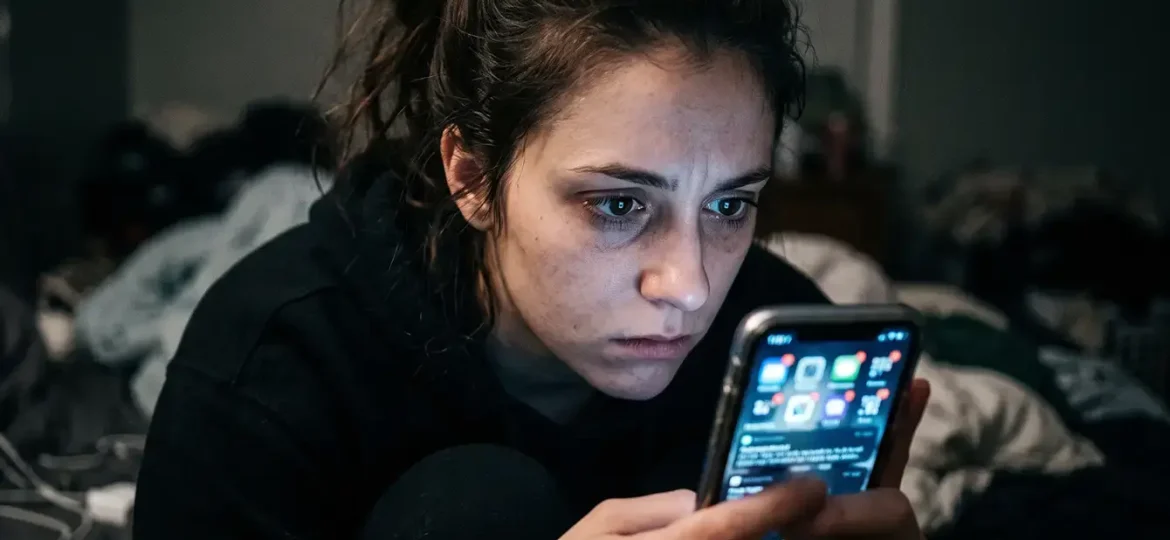
It is 3 PM, and you are staring at the same paragraph you started reading ten minutes ago. Your eyes are doing their part, moving across the words, but nothing is landing. You have been on screens since 7 AM, toggling between email, Slack, spreadsheets, and a parade of video calls. Your body is sitting still, but your brain feels like it has run a marathon. If you are searching for answers about neurofeedback for screen fatigue, chances are this feeling is all too familiar.
If this is your daily reality, you are not lazy, you are not losing your edge, and you are not imagining it. What you are experiencing is screen fatigue, and it has a neurological basis that goes deeper than tired eyes or too much coffee. And the common advice to “just take a break” or “try the 20-20-20 rule” does not come close to addressing what is actually happening inside your skull.
Neurofeedback for screen fatigue addresses the problem at its root: the dysregulated brainwave patterns that chronic screen use reinforces and deepens over time. At the Los Angeles Neurofeedback Center, we work with professionals every day who are functioning at a fraction of their cognitive capacity, not because anything is wrong with their ambition or intelligence, but because their brains have been pushed into patterns that screens make worse with every passing hour.
What Screen Fatigue Actually Does to Your Brain
To understand why neurofeedback helps with screen fatigue, you first need to understand what hours of screen time actually do to your neurological landscape. It is not just “eye strain.” What is happening involves multiple brain systems being pushed into states they were never designed to sustain.
Excess High-Beta Activity
Your brain produces electrical patterns at different frequencies, and neuroscientists categorize these into bands: delta, theta, alpha, beta, and high-beta, from slowest to fastest. Research published in Frontiers in Human Neuroscience has documented these patterns extensively. Beta waves are associated with active thinking, concentration, and alertness. High-beta waves, the fastest of the group, are associated with intense focus, anxiety, and a heightened state of mental processing.
Screens push your brain into sustained high-beta activity. Every notification, every task switch, every new email arriving in your peripheral vision ramps up this fast-frequency processing. In short bursts, high-beta is useful. It is what allows you to meet a deadline or navigate a complex problem. But when your brain is locked in high-beta for hours on end, day after day, it becomes the neurological equivalent of driving with the engine redlined. You are burning cognitive fuel at an unsustainable rate. Your brain loses its ability to downshift into the calmer states needed for recovery and creative thought.
Default Mode Network Disruption
Your brain has a network that activates when you are not focused on any particular task. Neuroscientists call it the default mode network, and it is responsible for mind-wandering, self-reflection, creative thinking, and a sense of internal narrative continuity. It is, in many ways, the network that makes you feel like yourself.
Constant screen engagement suppresses the default mode network because screens demand continuous externally directed attention. Your brain never gets the “idle time” it needs to activate this network properly. Over months and years, this suppression can manifest as disconnection from yourself. You may struggle to access creativity, feel emotionally flat, or find it hard to think beyond the task in front of you. You are not depressed in the clinical sense, but you have lost access to the mental mode where insight, imagination, and self-understanding live.
Dopamine Dysregulation
Every ping, every notification, every new message creates a small dopamine hit in your brain. Dopamine is not the “pleasure chemical” that popular science often describes. It is more accurately the “anticipation chemical.” It drives you to seek, to check, to look for what is new. Screens exploit this system relentlessly.
The problem is that constant dopamine stimulation leads to downregulation. Your brain adjusts to the high volume of dopamine hits by becoming less sensitive to each one. The result is that you need more stimulation to feel the same level of engagement. At the same time, your capacity for sustained attention shrinks. This is why you can scroll your phone for an hour without enjoying any of it. A book that you used to love now feels impossible to finish. Your dopamine system has been recalibrated by screens, and everything else feels insufficiently stimulating by comparison.
Visual Cortex Fatigue and Autonomic Dysregulation
The visual cortex processes an enormous amount of information during screen use, much more than it handles during natural vision. Screens present a constant stream of high-contrast, rapidly changing visual data at a fixed focal distance. This sustained demand fatigues not just the eyes themselves but the neural circuits responsible for visual processing, contributing to the headaches, difficulty concentrating, and the sensation of cognitive heaviness that characterize screen fatigue.
Simultaneously, prolonged screen use keeps your autonomic nervous system tilted toward sympathetic activation, your “fight or flight” response. The combination of constant alertness, information overload, and physical immobility creates a neurological pattern that mirrors chronic stress. Your brain stays locked in a high-alert state even after you step away from the screen. Over time, this creates the paradox that defines screen fatigue. You are exhausted because your body needs rest, but your brain cannot stop firing.
Why “Just Take a Break” Does Not Fix the Underlying Problem
The standard advice for screen fatigue is maddeningly simple: take breaks, go for a walk, look at something twenty feet away every twenty minutes. This advice is not wrong, exactly. But it is like telling someone with chronic back pain to sit up straight. The tip addresses the moment without touching the underlying condition.
The reason breaks do not resolve screen fatigue is that the neurological patterns screens reinforce persist even when the screen is off. If your brain has been trained by months or years of excessive screen time to default to high-beta processing, suppress the default mode network, and dysregulate its dopamine response, a fifteen-minute walk does not undo those patterns. You come back to your desk, open your laptop, and your brain immediately snaps back into the same overdrive state it was in before you left.
This is why many people who take vacations find that the relief is temporary. Within a day or two of returning to work, they feel exactly the same as they did before the break. The vacation changed the inputs, but it did not change the brain’s habitual response to those inputs. The patterns are self-reinforcing. Your brain has, through repetition, gotten very efficient at the dysregulated state. It is not that it cannot do better. It is that it has forgotten how.
How Neurofeedback Addresses the Neurological Patterns Behind Screen Fatigue
Neurofeedback works differently from breaks, meditation apps, or other surface-level interventions because it communicates directly with the dysregulated brainwave patterns themselves. It does not ask you to try harder, focus better, or think your way out of the problem. Instead, it gives your brain the information it needs to recognize its own stuck patterns and begin correcting them.
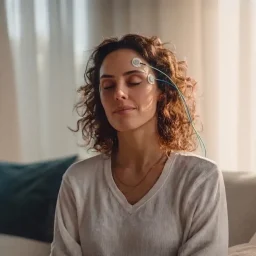
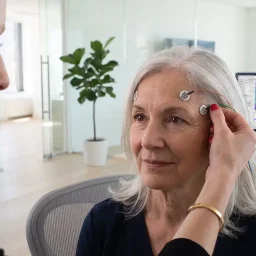
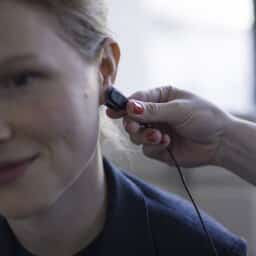
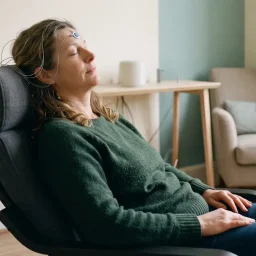
CLARITY Direct Neurofeedback, the system we use at the Los Angeles Neurofeedback Center, takes this a step further. It is a passive, micro-current approach that delivers an imperceptibly small signal to your brain during each twenty-minute session. You do not need to concentrate, perform tasks, or do anything at all. You simply sit comfortably while the system works.
Here is how to think about what CLARITY Direct Neurofeedback does for screen-fatigued brains. Imagine that your brain is a room full of radios, all tuned to slightly different stations and all playing at once. That is what excess high-beta, suppressed default mode activity, and dopamine dysregulation feel like from the inside: noise. CLARITY Direct Neurofeedback does not add more noise or try to overpower the existing cacophony. It gently nudges each radio back toward its proper station and volume level. The result is not silence. It is clarity. Each signal becomes distinct, manageable, and appropriately calibrated.
The Specific Patterns CLARITY Direct Neurofeedback Targets
For screen fatigue specifically, CLARITY Direct Neurofeedback addresses several interconnected neurological patterns. The excess high-beta activity that keeps your brain in constant overdrive begins to normalize. You do not lose the ability to focus intently when needed, but you regain the ability to downshift when the situation does not call for maximum alertness. The mental “idle” that felt impossible after years of screen-driven hyperactivation starts to come back.
The default mode network, which has been chronically suppressed by constant external attention demands, begins to reactivate during appropriate moments. Clients often describe this as a return of something they did not realize they had lost. The ability to read a book for pleasure, to hold a thought without interruption, or to end the workday without feeling mentally destroyed comes back naturally.
Dopamine sensitivity begins to recalibrate as well. As the brain’s overall regulatory patterns improve, the dopamine system stops requiring the constant high-frequency stimulation that screens provide. You start finding satisfaction in slower activities again. The book on the nightstand becomes genuinely appealing. A conversation holds your attention without competing against the pull of your phone. This is not willpower. It is your neurochemistry returning to a healthier baseline.
How Quickly Neurofeedback for Screen Fatigue Produces Results
One of the advantages of CLARITY Direct Neurofeedback is that changes often begin early. Many clients notice shifts within the first one to three sessions. The nature and depth of those changes grow with each visit.
Think of the volume knob metaphor for mental noise. After your first few sessions, the volume has not dropped to zero. But it has come down from an eight to a six. You can hear yourself think again. By sessions four to six, it might be down to a four. The noise is still there, but it is no longer dominating the room. By the end of a full course, many clients describe the mental noise as a quiet background hum. It no longer dominates their attention or drains their energy the way it used to.
For screen fatigue specifically, early changes often show up as improved sleep quality and a more natural ability to “power down” at the end of the workday. The wired-but-exhausted feeling, that state where your body is tired but your brain will not stop churning, tends to be one of the first things to ease. Following that, clients typically notice improved sustained attention during work, less compulsive phone checking, and a reduction in the afternoon mental fog that characterizes screen-driven cognitive fatigue.
The Los Angeles Neurofeedback Center is open seven days a week, with appointments available as early as 7 AM on weekdays, specifically because many of our clients are working professionals whose schedules are demanding. You can fit a twenty-minute session in before your first meeting of the day. You will still arrive at your desk feeling sharper than usual.
Strategies That Work Alongside Neurofeedback for Screen Fatigue
Neurofeedback addresses the neurological foundation, but there are practical strategies that enhance and accelerate the process when used in combination.
HeartMath biofeedback is one of the most effective complements to neurofeedback for screen fatigue. While neurofeedback works with your brainwave patterns, HeartMath trains your heart rate variability, which is the variation in time between heartbeats. Higher heart rate variability is associated with better stress resilience, emotional regulation, and cognitive flexibility. Learning HeartMath techniques gives you a tool you can use in real time, at your desk, during the workday, to interrupt the stress response that screens continuously trigger. The difference between neurofeedback and biofeedback is that they target different systems, brain and body respectively, which is why they work so well together.
Strategic screen hygiene also matters, but the specific practices matter more than the general advice. Rather than simply “taking breaks,” consider restructuring your workday to batch similar tasks together, reducing the cognitive cost of constant context-switching. If possible, designate specific blocks for email and messaging rather than leaving them open as a constant stream of interruptions. Each notification you prevent is one fewer dopamine trigger your brain has to process.
Physical movement that involves coordination rather than repetition tends to be particularly beneficial. Walking is good. Activities that require your brain to coordinate complex physical movements, like rock climbing, dance, martial arts, or even juggling, are better because they engage neural circuits that screens leave dormant. The goal is not fitness, though that helps too. The goal is giving your brain input that is fundamentally different from the two-dimensional, fixed-distance, rapid-switching input that screens provide.
For clients who want to continue neurofeedback training outside of sessions, Myndlift remote neurofeedback provides a supervised at-home option that can extend the benefits of in-office sessions into your daily routine.
Taking the First Step
If screen fatigue has become your default state rather than an occasional bad day, neurofeedback offers a path forward. It does not just manage symptoms. It retrains the neural patterns driving them. The patterns that screens have reinforced in your brain are real, but they are not permanent. Your brain is capable of extraordinary adaptation. It just needs the right input to remember how.
You can book a session at the Los Angeles Neurofeedback Center online, or call us at 323-705-3031. We are open seven days a week, and many of our clients see us before their workday begins so they can start the day with a brain that is already functioning better, not one that is already behind.
Frequently Asked Questions
Is screen fatigue the same as burnout?
Screen fatigue and burnout overlap significantly, but they are not identical. Burnout is a broader syndrome that involves emotional exhaustion, cynicism, and reduced professional efficacy, often driven by workload, lack of autonomy, or value misalignment. Screen fatigue is a specific neurological response to sustained digital input that can exist independently of burnout or as a component of it. You can experience screen fatigue without being burned out on your job, and you can be burned out without screens being the primary driver. That said, for knowledge workers, screen fatigue is often a major contributor to burnout because the cognitive depletion it causes makes every other aspect of work feel harder. Neurofeedback can address the neurological component of both conditions.
How is neurofeedback for screen fatigue different from just meditating?
Meditation and neurofeedback both influence brainwave patterns, but they work through different mechanisms. Meditation asks you to actively practice a skill, shifting your attention, observing your thoughts, cultivating a particular mental state. This is valuable, but it requires effort and consistency, and it is particularly difficult when your brain is already in a state of cognitive depletion. Neurofeedback works passively. You do not need to concentrate, focus, or do anything during the session. The technology communicates directly with your brain’s electrical patterns. Think of it this way: meditation is like learning to drive a car with a manual transmission, while neurofeedback is like having a mechanic tune the engine. Both improve performance, but they work on different levels and complement each other well.
Will neurofeedback make me less productive if I need to use screens for work?
The opposite tends to happen. Neurofeedback does not reduce your ability to use screens. It restores your brain’s ability to use them efficiently without paying such a heavy cognitive tax. Clients who complete a course consistently report greater productivity and sustained focus throughout the day. They accomplish more with less mental effort. You also tend to recover faster from intensive screen use, so your cognitive performance remains more consistent throughout the day rather than falling off a cliff by mid-afternoon.
How many sessions do I need specifically for screen fatigue?
A typical course of CLARITY Direct Neurofeedback involves fifteen to twenty-five sessions, regardless of the specific concern being addressed. For screen fatigue, many clients report noticeable improvements in the first one to three sessions, with more substantial and stable changes developing over sessions four through twelve. The total number depends on how long the patterns have been in place. Co-occurring conditions like anxiety or insomnia may add a few sessions.com/anxiety-treatment-help/”>anxiety or insomnia that are contributing to the overall picture. Your clinician will give you a more specific estimate after your intake.
Can I do neurofeedback during my lunch break?
Absolutely. CLARITY Direct Neurofeedback sessions take approximately twenty minutes, and including sensor setup and a brief check-in, most clients are in and out within thirty minutes. Our location in Los Angeles is accessible to many professionals, and we are open as early as 7 AM on weekdays. Many of our clients schedule sessions before work, during lunch, or immediately after the workday ends. The session itself is relaxing rather than draining, so you return to your afternoon with more cognitive capacity, not less.