

You have built an entire career around compensating. You arrive early because you know it takes you longer to settle in. Elaborate systems of lists, alarms, and reminders fill your days because your working memory lets things slip without them. You rehearse conversations in advance. Social events leave you drained in a way that nobody around you seems to understand. You have gotten very good at making it all look effortless, and the effort of making it look effortless is slowly wearing you down. Neurofeedback for neurodivergent adults addresses exactly this kind of neurological exhaustion.
If you are a neurodivergent adult navigating a professional life, whether you carry a formal diagnosis of ADHD, autism, or something that has never quite been named, you already know that the standard advice does not always fit. Productivity tips designed for neurotypical brains can feel like trying to run software on the wrong operating system. Medication helps some people and not others. Therapy gives you insight, but insight alone does not change the fact that your brain processes information differently than the workplace assumes it should.
Neurofeedback for neurodivergent adults offers something different. It does not try to make you neurotypical. It helps your brain work more efficiently on its own terms.
The Cost of Masking and Compensating
Masking is the word for it, and it describes exactly what it sounds like. You put on a performance of neurotypical behavior while your internal experience is something entirely different. Maintaining eye contact takes conscious effort. You suppress the urge to stim. Open-plan office noise makes focused thinking nearly impossible, but you push through it anyway. You smile through small talk that drains you when you could be deep in focused work.
The research is clear that chronic masking leads to burnout. Not the ordinary “I need a vacation” kind, but a deeper neurological exhaustion where the brain’s regulatory systems become depleted. Executive function deteriorates. Emotional regulation gets harder. Sleep quality drops. Anxiety and depression creep in, not as separate conditions but as consequences of a brain that has been running in overdrive for too long. The brain is not defective. It is exhausted and disorganized from years of compensating.
How Neurofeedback for Neurodivergent Adults Helps Without Changing Who You Are
This is the part that matters most. Neurofeedback for neurodivergent adults is not about correcting your brain into a neurotypical pattern. It is about helping your brain regulate itself more efficiently so that the things that are hard for you become less hard. Executive function, sensory filtering, emotional regulation, attention shifting. These are all regulated by specific brain patterns, and when those patterns are stuck or disorganized, everything requires more effort than it should.
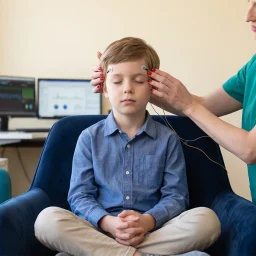
CLARITY Direct Neurofeedback works by delivering a micro-current signal that is far too small to feel. It does not stimulate the brain. It gently disrupts the stuck patterns that are causing the dysregulation, and the brain’s own self-correcting mechanisms do the rest. This means the changes that happen are your brain finding its own best configurations, not a machine imposing an external standard.
Sessions last about 20 minutes. You do not have to concentrate, play a game, or do anything active. Most people simply sit and relax. This is particularly important for neurodivergent adults because traditional neurofeedback, which requires sustained attention and effort over 40 or more sessions, can be its own form of masking. You should not have to perform neurotypical behavior in order to receive treatment for the exhaustion of performing neurotypical behavior.
What Changes Look Like in Practice
The shifts tend to be subtle at first and then gradually become obvious. A client might notice that they can sit through a meeting without their mind racing in three directions. The afternoon energy crash becomes less severe. They stop needing to reread the same email four times before responding. Transitions between tasks, which used to require enormous mental effort, start feeling more fluid.
For many neurodivergent adults, the most meaningful change is a reduction in the internal noise. That constant background hum of overstimulation, worry about forgetting something, and tension from managing a dozen invisible demands. When the brain is better regulated, you have more capacity. Not because you have been changed into someone else, but because your brain is no longer spending so much energy just trying to hold itself together.
Published research on neurofeedback for neurodivergent adults with ADHD has documented improvements in attention, impulse control, and executive function that persist after treatment ends. These findings align with what we observe in our practice. The goal is lasting change, not dependence on ongoing sessions. A typical course is 15 to 20 sessions, and the improvements tend to hold because they reflect genuine reorganization in the brain’s electrical patterns.
You Deserve to Stop Running on Empty
If you have spent years being told that you just need to try harder, get more organized, or develop better habits, you know how inadequate that advice can feel. The issue has never been effort. You have been putting in more effort than most people around you realize. The issue is that your brain needs support at the neurological level, not just another productivity system or coping strategy.
At Los Angeles Neurofeedback Center, we provide neurofeedback for neurodivergent adults who are high performers, creative thinkers, and deeply capable people who are simply running out of capacity to keep compensating. We see you. And we know the answer is not to push harder. It is to help your brain find a more sustainable way to do what it already does well.
If this resonates, we would love to talk with you. You can book a session or reach out to start the conversation.
Frequently Asked Questions
Do I need a formal diagnosis to try neurofeedback?
No. Many of our adult clients come in knowing that something about how their brain works is different, even without a specific diagnosis. Your experience is valid whether or not a clinician has formally categorized it.
Can I continue taking ADHD medication during neurofeedback?
Yes. Neurofeedback does not conflict with stimulant or non-stimulant ADHD medications. Some clients find that as their brain becomes better regulated through neurofeedback, they are able to reduce their medication dosage in consultation with their prescribing physician. Others continue both. The decision is always between you and your doctor.
How is this different from therapy or coaching for ADHD?
Therapy and coaching work at the behavioral and psychological level, helping you develop strategies and process experiences. Neurofeedback works at the neurological level, addressing the brain patterns that make executive function, attention, and regulation harder than they should be. They complement each other well. Many clients do both and find that the neurological improvements from neurofeedback make therapeutic and coaching strategies easier to implement.
Will neurofeedback make me less creative or change my personality?
No. This is a common concern among neurodivergent adults, and it is an important one. Neurofeedback does not flatten your personality or reduce the qualities that make you who you are. What it does is reduce the friction. The creativity, the pattern recognition, the ability to hyperfocus on things you care about. Those stay. What typically decreases is the overwhelm, the mental fatigue, and the difficulty regulating attention when you need to.
Is neurofeedback for neurodivergent adults covered by insurance?
Coverage depends on your insurance provider and plan. Some plans cover neurofeedback under mental health or rehabilitative services, especially when there is a documented diagnosis like ADHD. We can provide the necessary documentation and codes for you to check with your insurance company or submit claims.