

If your child has been diagnosed with ADHD and you are uneasy about putting them on stimulant medication, you are not a bad parent for feeling that way. You are a thoughtful one. More families across Los Angeles are actively searching for a non-medication ADHD treatment for children in Los Angeles, and neurofeedback is quickly becoming the answer that makes the most sense.
The concerns are real. Adderall and Ritalin work for some kids, but the side effects worry a lot of parents: appetite suppression, sleep disruption, mood changes, and the question of what long-term stimulant use does to a developing brain. These are fair things to think about. And you deserve to know that medication is not the only evidence-based option available to your child.
At Los Angeles Neurofeedback Center in Brentwood, we work with families every week who came to us with that exact dilemma. This guide walks you through what neurofeedback is, how it helps kids with ADHD, and what you can realistically expect as a parent.
Why LA Parents Are Looking Beyond Stimulant Medication for ADHD
ADHD diagnoses among children have been rising steadily for over a decade. The CDC reports that millions of children in the U.S. have received an ADHD diagnosis, and the numbers continue to climb. In Los Angeles, where academic pressure starts early and extracurricular schedules are packed, parents are feeling the weight of that diagnosis more than ever.
For many families, the first recommendation from a pediatrician or psychiatrist is stimulant medication. And those medications do help a lot of kids focus in the short term. But parents are increasingly asking what happens beyond the short term. What happens when the medication wears off each afternoon and their child crashes? What happens to their appetite, their sleep, their personality?
These are not fringe concerns. They are the most common questions we hear from parents walking into our office for the first time. And the fact that you are reading this article tells us you are asking them too.
How Neurofeedback Works as a Non-Medication ADHD Treatment for Children
ADHD is not a willpower problem. It is a brainwave pattern problem. Children with ADHD typically show an excess of slow-wave theta activity in the frontal lobes, the area of the brain responsible for attention, impulse control, and executive function. Their brains are, in a simplified sense, producing too many “idle” waves when they should be producing focused, engaged ones.
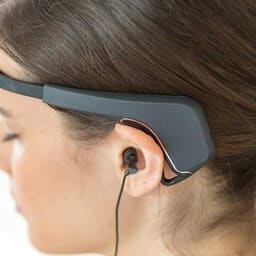
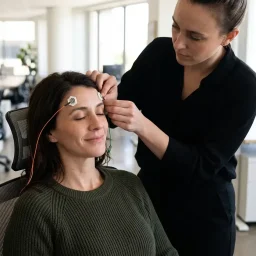
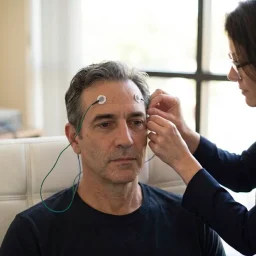
Neurofeedback trains the brain to shift out of those patterns. During a session, sensors placed on your child’s scalp read their brainwave activity in real time. When the brain produces patterns associated with focus and calm attention, the feedback on screen reinforces those patterns. When the brain drifts into the scattered, unfocused range, the feedback gently guides it back.
Over time, the brain learns to stay in those healthier patterns on its own, without medication prompting it to do so. Think of it like physical therapy after an injury. You are building strength in a specific area so the body can function properly without external support.
And here is the part that matters most to parents: the American Academy of Pediatrics has rated neurofeedback as a Level 1 “Best Support” intervention for ADHD, placing it at the same evidence level as medication and behavioral therapy. This is not experimental. It is mainstream, research-backed treatment.
What a Neurofeedback Session Actually Looks Like for a Child
This is usually the first question parents ask, and the answer tends to put them at ease immediately.
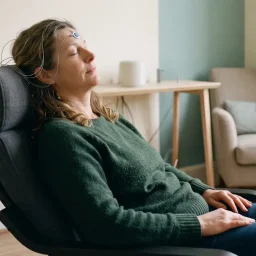
Your child sits in a comfortable chair. Small sensors are placed on their head. They do not hurt, they do not buzz, and most kids barely notice them after the first minute. Then your child watches a screen. Depending on their age and preferences, the feedback might look like a simple video game, an animation, or a movie that brightens and dims based on their brainwave activity.
When their brain is in a focused state, the game responds positively. When their brain drifts, the feedback pauses or dims. Your child does not have to consciously do anything. Their brain picks up on the feedback naturally and starts adjusting. Most kids actually enjoy the sessions because, from their perspective, they are just watching something on a screen.
Sessions typically run 30 to 45 minutes. We also offer CLARITY Direct Neurofeedback, which is a shorter format that some younger children respond to especially well. There is no homework, no stress, and no pressure on your child to perform. That matters when you are working with a kid who already feels like school is a daily battle.
What Results to Expect and How Long It Takes
Parents typically start noticing changes within the first 8 to 12 sessions. The early signs are often things you observe at home before they show up at school: your child falls asleep more easily, their mood is more stable, they are less reactive to frustration, and they seem more present during conversations.
As training continues, the academic and behavioral improvements tend to follow. Teachers may comment that your child is staying on task longer, completing assignments more consistently, or participating more in class. These are signs that the brainwave patterns are shifting in a meaningful way.
A full treatment protocol for children with ADHD typically runs 20 to 40 sessions, depending on the severity of the symptoms and how your child’s brain responds. Some kids see dramatic improvement in 20 sessions. Others need closer to 40 before the changes fully stabilize. We monitor progress through periodic qEEG brain maps and adjust the protocol as needed.
The key difference between neurofeedback and medication is what happens after treatment ends. With medication, the benefits stop when the prescription stops. With neurofeedback, the brain has learned new patterns. Those patterns tend to hold, which means your child is not dependent on ongoing treatment to function well.
Addressing the Questions Every Parent Has
“Is this safe for my child?” Yes. Neurofeedback is non-invasive. Nothing is being put into your child’s body and no electrical current is being sent to their brain. The sensors only read brainwave activity. The most common side effect is mild tiredness after a session, similar to how a child might feel after a good day of focused learning.
“Will my kid actually cooperate?” Almost always, yes. The sessions feel like screen time to kids, not therapy. We have worked with children as young as five who look forward to their appointments. If your child can sit and watch a screen for 20 minutes, they can do neurofeedback.
“Can we try this before starting medication?” Absolutely. Many families come to us specifically because they want to explore non-medication options first. There is no requirement to try medication before starting neurofeedback, and many parents find that neurofeedback is enough on its own.
“What if my child is already on medication?” That is fine too. Neurofeedback works alongside medication, and many families use it as a path to eventually reducing or discontinuing stimulants under their doctor’s guidance. We coordinate with your child’s pediatrician or psychiatrist throughout the process.
Taking the First Step for Your Child
If your child is struggling with ADHD and you want to explore a path that does not start with a prescription pad, we would love to talk with you. At Los Angeles Neurofeedback Center, your child’s first session starts at just $89. That includes a consultation where we learn about your child’s specific challenges, answer every question you have, and help you decide whether neurofeedback is the right fit for your family.
We are located at 12121 Wilshire Blvd., Suite 810, in Brentwood. Our office is open seven days a week, and we are happy to work around school schedules. You can learn more about our approach to ADHD treatment and learning disabilities on our website or call/text us directly at (323) 705-3031.
Your child’s brain is still growing and developing every single day. The earlier you address the patterns driving their ADHD, the more room you give that brain to thrive. You are already doing the right thing by looking into this. Let us help you take the next step.
Frequently Asked Questions About Neurofeedback for Children with ADHD
At what age can a child start neurofeedback for ADHD?
Most children can begin neurofeedback as early as age five, as long as they are able to sit and watch a screen for 20 to 30 minutes. Younger children often do very well with CLARITY Direct Neurofeedback, which requires even shorter sessions. The qEEG brain map we do before starting treatment helps us determine the best protocol for your child’s age and developmental stage.
Is neurofeedback for ADHD as effective as medication in children?
The American Academy of Pediatrics has rated neurofeedback as a Level 1 “Best Support” intervention for ADHD, which places it at the same evidence level as stimulant medication and behavioral therapy. The key advantage of neurofeedback is that the improvements tend to last after treatment ends, while medication only works as long as your child continues taking it.
Will neurofeedback change my child’s personality?
No. One of the most common complaints parents have about stimulant medication is that it makes their child seem flat, withdrawn, or “not themselves.” Neurofeedback does not work that way. It trains your child’s brain to regulate itself more effectively, which usually means they feel more like themselves, not less. Parents frequently tell us their child seems happier, calmer, and more engaged after treatment.
How do I know if my child’s ADHD is severe enough for neurofeedback?
There is no minimum severity threshold for neurofeedback. Whether your child has mild attention difficulties or a more significant ADHD diagnosis, the qEEG brain map will show us exactly what is happening in their brain. If the patterns associated with ADHD are present, neurofeedback can help retrain them. If the brain map shows something unexpected, we will be transparent about what we find and what we recommend.
Can neurofeedback help with ADHD-related behavioral issues, not just focus?
Yes. The brainwave patterns that drive inattention in ADHD are closely connected to impulse control, emotional regulation, and frustration tolerance. As those patterns improve through training, parents commonly see reductions in meltdowns, defiance, and emotional reactivity alongside improvements in focus and task completion. Many families report that the behavioral changes are actually the first things they notice.
Will my child need neurofeedback sessions forever?
No. Neurofeedback is a training-based approach, not a maintenance-based one. A typical protocol for children with ADHD runs 20 to 40 sessions. Once your child’s brain has learned the new patterns, those patterns tend to hold. Some families choose to do occasional tune-up sessions during high-stress periods like the start of a new school year, but ongoing treatment is not required.
Does neurofeedback help with ADHD-related learning difficulties like reading or math?
Many children with ADHD also struggle with learning because the same attention and processing deficits that affect behavior also affect academics. As neurofeedback improves focus, processing speed, and working memory, parents often see a carry-over effect into schoolwork. We also work with children who have been diagnosed with specific learning disabilities, and neurofeedback can be a helpful part of their broader support plan.
My child has tried therapy and behavioral interventions without much improvement. Will neurofeedback be different?
It can be, because neurofeedback works at a different level. Behavioral interventions and therapy address how your child thinks and acts. Neurofeedback addresses the underlying brainwave patterns that make focused thinking and regulated behavior harder in the first place. For many children, combining neurofeedback with behavioral strategies produces better results than either approach alone, because the brain training gives the behavioral tools something solid to build on.