

You have probably felt it without having a name for it: the persistent hum of tension that does not go away even when the stressful situation has passed. The racing thoughts at 2 a.m. when there is nothing to race about. The way your body startles at a sound that your rational mind knows is harmless. These are not personality flaws or signs of weakness. They are symptoms of a central nervous system that has gotten stuck in a state of high alert—and learning how to calm your central nervous system is one of the most consequential things you can do for your mental and physical health.
The internet is full of advice on this topic, most of it superficial. Take a bath. Try yoga. Drink chamomile tea. These suggestions are not wrong, but they rarely address why your nervous system is dysregulated in the first place or what to do when everyday calming strategies are not enough. This article goes deeper. We explain what is actually happening in your brain and body when your nervous system is stuck in overdrive, which self-regulation techniques have genuine evidence behind them, and what clinical options exist when those techniques hit their ceiling.
Why Your Central Nervous System Gets Stuck in Overdrive
Your central nervous system—the brain and spinal cord—works in partnership with your autonomic nervous system to regulate how you respond to the world. The autonomic system has two branches: the sympathetic branch, which activates your fight-or-flight response, and the parasympathetic branch, which activates your rest-and-digest state. In a well-regulated system, these branches shift fluidly depending on what the situation demands. Threat appears, sympathetic activates. Threat passes, parasympathetic takes over and you return to baseline.
The problem is that chronic stress, trauma, anxiety, and certain neurological conditions can disrupt this balance. The sympathetic branch stays activated even when there is no external threat. Harvard Health describes this as a stress response that has been “turned on so often that the body has difficulty shutting it off.” The result is a nervous system operating in a chronic state of hypervigilance—elevated cortisol, disrupted sleep, heightened startle response, difficulty concentrating, irritability, digestive issues, and a general sense of being “wired but tired.”
At the brain level, this often shows up as excess high-beta brainwave activity in frontal regions—the electrical signature of a mind that is running too fast and scanning for threats that are not there. This is not something you can willpower your way out of. The patterns are neurological, not psychological, which is why calming techniques that work at the behavioral level sometimes fail to produce lasting change for people with deeply entrenched dysregulation. Understanding these patterns is the first step toward finding approaches that genuinely calm central nervous system overactivation at its source.
Self-Regulation Techniques That Actually Work
Before discussing clinical interventions, it is worth understanding which approaches to calm central nervous system activation have genuine evidence behind them—not because they are sufficient for everyone, but because they form a foundation that clinical treatment can build on.
Controlled breathing. Slow, diaphragmatic breathing with an extended exhale directly activates the vagus nerve, which is the primary communication pathway between your brain and your parasympathetic nervous system. This is not placebo. The mechanism is well-documented: a longer exhale relative to your inhale shifts autonomic balance toward the parasympathetic branch. Techniques like box breathing (four counts in, four counts hold, four counts out, four counts hold) or physiological sighs (double inhale through the nose, extended exhale through the mouth) produce measurable reductions in heart rate and cortisol within minutes.
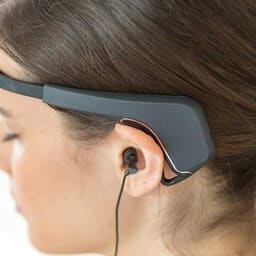
Heart rate variability training. HRV biofeedback takes controlled breathing a step further by providing real-time feedback on how effectively your breathing is influencing your heart rhythm. At Los Angeles Neurofeedback Center, we use HeartMath biofeedback to train clients in achieving physiological coherence—a measurable state where heart rhythm, breathing, and autonomic function align. A study in Applied Psychophysiology and Biofeedback found that HRV biofeedback improved attention and reduced symptoms of anxiety and ADHD, confirming that training the autonomic nervous system has direct effects on cognitive and emotional regulation.
Physical movement. Exercise completes the stress cycle that your body started when it activated fight-or-flight. When your sympathetic nervous system fires, it prepares your muscles for action. If that energy has nowhere to go—because the threat is psychological, not physical—it stays trapped in the body as tension and agitation. Walking, running, swimming, or any sustained physical activity burns off that activation and signals to your nervous system that the threat has been resolved.
When Self-Care Hits a Ceiling: Clinical Nervous System Regulation
For many people, the techniques above provide meaningful relief. But for others—especially those dealing with chronic anxiety, trauma history, PTSD, or years of accumulated stress—self-regulation alone is not enough to calm central nervous system dysregulation. The nervous system’s dysregulation is too deeply entrenched. Breathing exercises bring temporary calm, but the baseline keeps resetting back to overdrive. This is not a failure of willpower or technique. It is a sign that dysregulation exists at the neurological level, in the brain’s electrical patterns themselves.
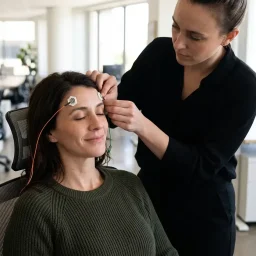
This is where neurofeedback enters the picture. Neurofeedback works directly with brainwave activity, training the central nervous system to shift out of the stuck patterns that drive chronic hyperactivation. At LANC, we use CLARITY Direct Neurofeedback, which delivers an imperceptible micro-current signal that gently disrupts the dysregulated brainwave patterns. The brain responds by reorganizing toward healthier configurations by reducing the excess high-beta activity that fuels anxiety and hypervigilance. It also restores the flexible shifting between sympathetic and parasympathetic states that a well-regulated nervous system requires.
Sessions are brief, passive, and require no effort from the client. Most people begin noticing changes within the first few sessions: less reactivity, better sleep, a quieter mind, and a sense of the nervous system finally downshifting into a calmer baseline—evidence that neurofeedback can effectively calm central nervous system patterns that self-care alone could not reach.
The critical difference between neurofeedback and self-regulation techniques is durability. Breathing exercises calm the nervous system in the moment. Neurofeedback trains the brain to maintain a calmer baseline on its own, long term. Over a course of 20 to 40 sessions, the brain learns new patterns that persist after sessions end. For clients with anxiety, insomnia, PTSD, or chronic stress, this combination of immediate self-regulation skills and lasting neurological change is often what produces the most complete recovery.
Finding the Right Starting Point
If you are experiencing nervous system dysregulation, learning to calm central nervous system overactivation starts with understanding the severity and duration of your symptoms. For mild, situational stress, self-regulation techniques—controlled breathing, physical movement, and lifestyle adjustments—may be sufficient. For chronic dysregulation that has persisted for months or years, or for symptoms rooted in trauma, anxiety disorders, or neurological conditions, a consultation will give you a clearer picture of what is happening and what it will take to resolve it.
At Los Angeles Neurofeedback Center, we offer consultations for people who want to understand whether their nervous system dysregulation would benefit from intervention. Our practitioners specialize in neurofeedback and biofeedback, and we work collaboratively with therapists, psychiatrists, and physicians to ensure that biofeedback fits within your broader care plan. You can book a session or consultation online or call the clinic directly. Whether you need breathing techniques, HRV biofeedback, neurofeedback, or a combination, we will give you an honest assessment of where to start.
Frequently Asked Questions: Calming the Central Nervous System
What are the signs that your central nervous system is dysregulated?
Common signs include chronic anxiety or a feeling of being “on edge” without an identifiable cause, difficulty falling or staying asleep, an exaggerated startle response, racing thoughts, irritability or emotional reactivity that feels disproportionate to the situation, muscle tension that does not resolve with stretching or massage, digestive issues, brain fog, and a persistent sense of fatigue despite adequate rest. If these symptoms have persisted for weeks or months and everyday calming strategies are not resolving them, the dysregulation may be neurological rather than purely situational, and an assessment can identify the specific patterns involved.
How long does it take to calm a dysregulated nervous system?
The timeline depends on the severity and duration of the dysregulation. Self-regulation techniques like controlled breathing and HRV biofeedback can produce noticeable calming effects within minutes to days. Neurofeedback typically produces initial changes within the first one to three sessions, with stable, lasting improvement emerging over a course of 15 to 25 sessions. The improvements are cumulative and tend to be enduring once the brain has learned healthier regulatory patterns.
Does neurofeedback actually calm the central nervous system?
Yes. Neurofeedback directly addresses the brainwave patterns that drive nervous system dysregulation. CLARITY Direct Neurofeedback delivers a gentle micro-current signal that disrupts stuck patterns and allows the brain to reorganize toward healthier baselines. The result is a measurable reduction in the excessive high-frequency brainwave activity associated with anxiety, hypervigilance, and sympathetic nervous system overactivation.
What is the difference between calming your nervous system and treating anxiety?
Calming the nervous system is a broader concept that encompasses anxiety but extends beyond it. Anxiety is one symptom of nervous system dysregulation, but the same underlying dysregulation can also produce insomnia, chronic pain, digestive problems, brain fog, and emotional reactivity. Treatments that focus narrowly on anxiety—such as anti-anxiety medication—may relieve that one symptom without addressing the nervous system’s overall regulatory capacity. Neurofeedback and biofeedback train the nervous system itself, which often resolves multiple symptoms simultaneously because they share a common neurological root.
Can you calm your nervous system permanently, or does it require ongoing maintenance?
Neurofeedback produces changes in the brain’s electrical patterns that are designed to be enduring. Once the brain has learned to self-regulate more effectively, it maintains those patterns without ongoing sessions—similar to how physical therapy strengthens a muscle that then stays strong through normal use. A “Tune-up” session is often recommended every 6 months after completing the protocol. Self-regulation skills like HRV biofeedback and breathing techniques remain useful as everyday tools regardless of whether you have completed neurofeedback.
Is neurofeedback better than medication for calming the nervous system?
They work through different mechanisms. Medication alters brain chemistry to reduce symptoms for as long as you take it. Neurofeedback trains the brain’s own electrical regulation, producing changes that persist after treatment is complete. For people who want a non-medication approach or who have found that medication alone does not fully resolve their symptoms, neurofeedback offers a complementary or alternative path. Many clients at LANC begin neurofeedback while still taking medication and, as their brain learns to self-regulate, work with their prescribing physician to reduce their dosage over time. The best approach depends on the individual—we provide honest assessments during consultations about what combination is likely to produce the best outcome for each person’s situation.