

You know the thought is irrational. You have told yourself a hundred times that the door is locked, that your hands are clean, that nothing terrible will happen if you do not check one more time. Knowing does not help. The thought comes back. The urge follows. And you perform the ritual not because you believe it will prevent disaster, but because the discomfort of not doing it is unbearable. The cycle repeats. The relief never lasts. And you are exhausted from living inside a brain that will not let go. Neurofeedback for OCD targets the source of that loop.
If you have obsessive-compulsive disorder, you already understand something that most people do not: OCD is not about being particular or organized. It is about being trapped in a pattern that your own mind generates and your own willpower cannot override. You may have tried medication. You may have done exposure and response prevention therapy. These are legitimate treatments, and they help many people. But if you are still struggling, it is not because you are not trying hard enough. It is because the pattern lives deeper than effort can reach.
Neurofeedback for OCD works at that deeper level, the electrical patterns in the brain that keep the loop running.
The Brain Circuitry Behind OCD
Neuroimaging research has given us a clear picture of what happens in the OCD brain. There is a circuit that connects the orbitofrontal cortex, the anterior cingulate cortex, and the caudate nucleus. In people without OCD, this circuit performs a useful function: it detects potential threats, evaluates them, and clears them once the appropriate action has been taken. You notice the stove might be on, you check it, your brain registers that it is off, and you move on.
In OCD, this circuit gets stuck. The threat detection fires, the checking behavior occurs, but the brain fails to register the completion signal. So the alarm keeps sounding. The thought keeps returning. The urge to act on it remains intense no matter how many times you perform the ritual. Research published through the National Institutes of Health has confirmed that this circuit shows hyperactivity in people with OCD, and the degree of hyperactivity correlates with symptom severity.
This is why willpower alone cannot solve OCD. You are not failing to think correctly. A circuit in your brain is firing in a pattern that it cannot break on its own. SSRIs can reduce the intensity of that firing by altering serotonin levels, and ERP therapy can teach you to tolerate the discomfort without performing the ritual. Both are valuable. But neither one directly addresses the electrical pattern itself.
How Neurofeedback Interrupts the OCD Loop
At Los Angeles Neurofeedback Center, in OCD cases, we typically see the expected overactivity in the frontal regions, along with other patterns that vary from person to person. Some people show elevated beta waves that correspond to the intense mental activity of obsessive thinking. Others show disrupted connectivity between brain regions that should be coordinating to resolve the thought cycle.
CLARITY Direct Neurofeedback delivers a micro-current signal that is completely imperceptible. You will not feel anything during the session. The signal gently disrupts the stuck patterns, the loops that your brain has been running over and over, and creates an opening for the brain to find a different configuration. It does not force a change. It provides the interruption that the brain has been unable to produce on its own.
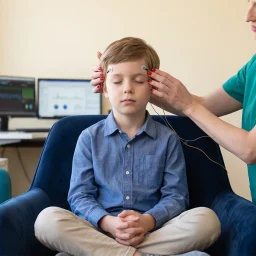
Sessions last about 20 minutes. You sit comfortably and do nothing. There is no concentration required, no exposure to triggers, no discomfort involved. For someone who spends their days battling their own thoughts, the passivity of the treatment is meaningful. You do not have to fight anything during a session. You simply sit and let the process work.
What Improvement Looks Like
We want to be transparent about what neurofeedback can and cannot do for OCD. It is not a cure. OCD is a complex condition, and anyone who promises to eliminate it entirely is not being honest. What neurofeedback does is turn down the volume. The obsessive thoughts may still occur, but they arrive with less intensity. The urge to perform the compulsion becomes easier to resist. The anxiety that follows resisting the urge becomes shorter and less overwhelming.
Many clients describe it as gaining space. Where the thought and the compulsion used to feel welded together, there is now a gap. A moment where you can choose. That gap is everything, because OCD thrives on the feeling that you have no choice. When the brain’s electrical patterns shift, the compulsory feeling weakens, and you get your agency back.
Clients also commonly report improvements in the secondary effects of OCD: better sleep, reduced general anxiety, improved ability to concentrate on things other than the obsessive content, and less emotional exhaustion at the end of the day. These changes make sense because the brain patterns that drive OCD overlap significantly with the patterns that drive anxiety and sleep disruption.
A typical course of treatment is 15 to 25 sessions, though OCD often benefits from sessions at the higher end of that range or beyond. We track progress throughout and adjust the approach based on what the brain map and your experience are telling us.
A Different Kind of Help
Living with OCD takes an enormous amount of energy that most people never see. The mental battles, the rituals hidden from public view, the shame that can come with a condition that others minimize or misunderstand. We see how hard you work just to get through a day, and we know it is more than most people realize.
Neurofeedback does not ask you to work harder. It does not ask you to expose yourself to your fears or push through discomfort. It works quietly, at the level of the brain’s electrical patterns, to give your overactive circuits a chance to settle. For many people with OCD, it is the first treatment they have tried that does not feel like another fight.
If you are interested in exploring whether neurofeedback could help with your OCD, we invite you to schedule a consultation and we will give you our honest assessment of how treatment could help. You can book a session or call us directly. You have fought this battle long enough to deserve a different kind of support.
Frequently Asked Questions
Can I continue ERP therapy while doing neurofeedback?
Yes, and many therapists find that the combination is more effective than either approach alone. ERP teaches you to tolerate the discomfort of resisting compulsions. Neurofeedback reduces the intensity of the obsessive signal, which makes the discomfort during ERP more manageable. The two approaches work on different levels of the same problem.
Does neurofeedback help with intrusive thoughts specifically?
Yes. Intrusive thoughts are generated by the same overactive brain circuits that drive the broader OCD pattern. As those circuits calm down through neurofeedback, intrusive thoughts typically become less frequent and less distressing. They may still occur occasionally, but they lose the sticky, urgent quality that makes them so consuming.
Can I do neurofeedback while on OCD medication?
Absolutely. Neurofeedback does not interact with SSRIs, clomipramine, or other medications commonly prescribed for OCD. Some clients find that neurofeedback allows them to reduce their medication dosage over time in consultation with their prescribing physician. Others continue both. The decision is always between you and your doctor.
What types of OCD respond to neurofeedback?
Neurofeedback addresses the underlying brain patterns rather than specific subtypes, so it can help across the spectrum of OCD presentations including contamination, checking, symmetry, harm-related obsessions, and purely obsessional OCD.
How long do the improvements last?
The changes from neurofeedback are lasting because they reflect genuine reorganization of the brain’s electrical patterns. Most clients maintain their improvements after completing treatment. Some return for occasional sessions during periods of high stress when OCD symptoms tend to intensify. OCD is a condition that can fluctuate over a lifetime, and neurofeedback provides a tool you can return to when needed.